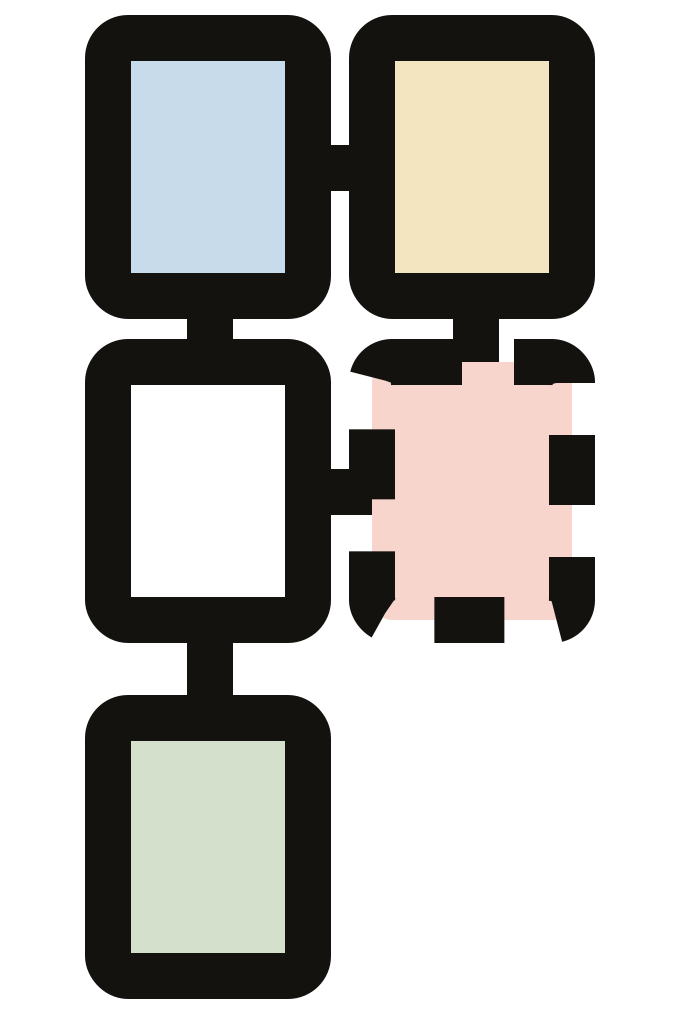
Their terms name a DPA. Did anyone publish it?
A missing sub-processor list is easy to overlook at signature and hard to explain at audit. Find out before you sign which documents the terms name that were never published, and which document takes precedence where two disagree.
Review a supplier before the first call, without a login or their sales team. Every gap you see points to its clause.
When we drew our own company's published terms, 9 of the 18 documents they referred to or required did not exist.
Legal reads the MSA, privacy the DPA. Nobody reads both.
Spread out and always changing
The MSA links to the DPA, the DPA links to a sub-processor list, and the acceptable use policy sits somewhere else. Any of them can change without notice.
The supplier can change what you approved
A change clause with no notice period and no right to object lets the supplier edit the terms after signature. See the clause quoted before you sign.
Different readers, different answers
Legal reads the MSA, privacy reads the DPA and security reads the trust page. Nobody reads the whole set, so nobody sees where one document contradicts another.
Found in the audit, not before signature
The missing DPA or the sub-processor list that was never published usually comes to light long after the contract is signed, when it is hardest to fix.
From a domain to a drawing in minutes
- Paradraw starts from the vendor's public legal pages. It only reads public HTML, never anything behind a login, so the vendor doesn't need to know or help. If they sent you documents directly, you can upload them as PDF, Word, HTML or text (up to 4 MB in total) as a private set that only your account can see.
- A draw takes about one to ten minutes. Each document appears on screen as it is read, the relationships draw in once they are known, and documents the terms name but nobody published show up as dashed outlines.
- Every conflict quotes at least two clauses, word for word. Every missing document comes with the scope of the search that failed to find it. A lawyer can check a finding in seconds without having to take it on trust.
What you get for each supplier
Missing documents named, not assumed
If the terms refer to a DPA, a sub-processor list or an SLA that isn't published, Paradraw lists it. You go into the call knowing what to ask for.
Conflicts quoted from both sides
When the MSA and the DPA disagree, you see both clauses in their exact wording, so the concern you take to the vendor is specific.
References to laws resolved, not flagged
A reference to a GDPR article or a similar public instrument is recognised as a public instrument. It won't be reported as a document the supplier failed to publish, so you don't chase false gaps.
Every supplier read against the same profile
Each report names the profile it was read against: EU B2B SaaS, version 2026.08. That gives you the same basis for every vendor, so your notes on one hold up next to your notes on another.
Non-English terms read the same way
A model decides clause topics, not a list of English keywords. A Swedish or German supplier's terms get the same cross-document reading as an English one.
A record security and compliance can stand behind
Findings describe what the documents say and never draw legal conclusions. If a page couldn't be read, the report says so and holds back the findings that page would have answered. You get a record you can defend.
Look at real drawings before you ask
The public directory already has drawings of 19 companies, many of them suppliers your team may be reviewing: Bokio, Cursor, Drata, Figma, Legora, Linear, Lovable, Mistral, MuchSkills, n8n, Notion, Pipedrive, PostHog, Retool, Sanity, Slack, Techquity, TypeSafe and Vanta. Each drawing has its own page listing the documents published, the documents named but not published, and how they connect.
Paradraw started in August 2026 as a way to read MuchSkills' own legal documents as a set. On the live site, 9 of the 18 documents the terms referred to or required did not exist.
Every public page has a route for the named company to put its answer on the record, unedited. Only deterministic findings count toward a public score. Judgement calls about a named company's terms are never part of it.
Questions from vendor reviewers
Paradraw reads every legal page the vendor publishes and lists each document their terms name but that it couldn't find, such as a DPA, a sub-processor list or a transfer mechanism. Each missing document comes with the scope of the search, so you can see where Paradraw looked. You find the gap before signature, not in the audit.
No. Paradraw's input is public HTML only, nothing behind a login, so a supplier terms review needs nothing from the vendor's sales or legal team. If the vendor sent you documents directly, you can upload them as a private set. It is visible only to your account and never listed in the directory.
No. Paradraw reports what the documents say and how they relate to each other. It never says a company is compliant, non-compliant or in breach, and it doesn't give legal advice. A build-time check flags any finding that drifts into a conclusion. What you get is the quoted clause, so your counsel can make the call.
Paradraw reports the page as unread. That happens when it only renders client-side, returns a 403 or can't be parsed. Any finding that page would have answered is held back rather than guessed. Where too little of the estate was read, Paradraw doesn't publish a score. You see what was covered and what wasn't.
Not yet. Change alerts, monitoring and cross-vendor comparison are not built. Today, Paradraw draws a supplier's estate as it stands when you run it, with each finding tied to the clause that produced it.
Three of Paradraw's five analysis passes are deterministic: reference, expectation and derived. The two judgement passes, edges and contradiction, run on Anthropic Claude, with DeepSeek as a second model to corroborate readings of public pages (never documents you upload). TypeSafe's Jev classifies document relationships and clause topics. Without an API key, the deterministic passes still run and the report says so.
Free shows the graph, every count and every structural finding. Fix costs €119 once and covers one company for thirty days, including the cross-document readings where conflicts show up. Accounts are invite-only for now, so start by asking for access.
Know what's missing before the call
Name a supplier and Paradraw reads its whole published legal estate. You see the documents it names but never published, and every conflict comes with its clauses quoted. Accounts are invite-only while we onboard reviewers.
Paradraw is built by Up Strategy Lab AB in Gothenburg, Sweden.